Editor’s Note: Device sizing frameworks shifted dramatically with recent Apple watch hardware updates, leaving many buyers confused about legacy accessory compatibility. This deep dive guide is continuously updated to unpack the technical design shifts separating overlapping case numbers. Our goal is to protect your hardware investments and ensure absolute data accuracy from your health sensors.
Here is fastest way to know that “What Does Size Group Mean for Apple Watch”?
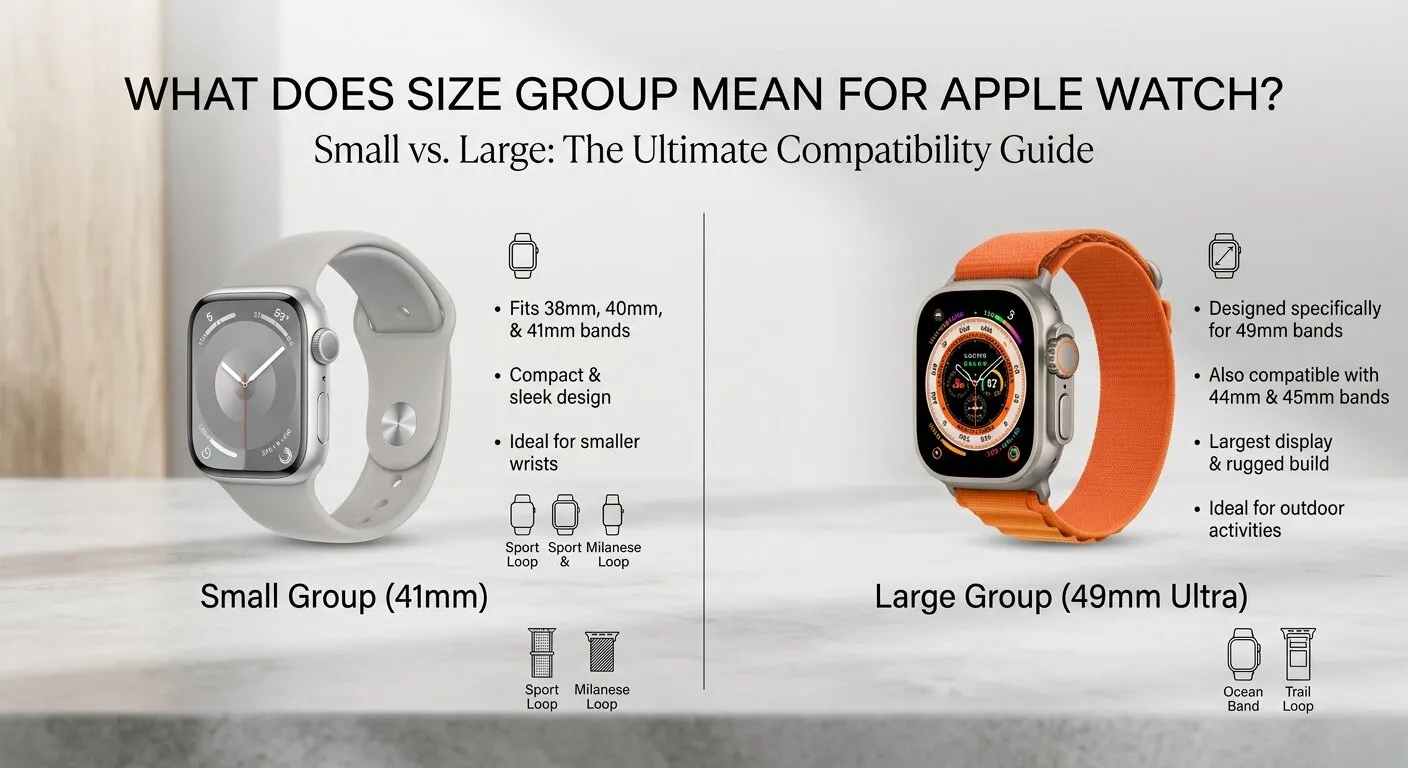
| Quick Answer Apple Watch bands come in two size groups: Small and Large. Small fits 38mm, 40mm, 41mm, and the new 42mm (Series 10+). Large fits the old 42mm (Series 1 to 3), 44mm, 45mm, 46mm, and 49mm (Ultra). Always check the size group ,not just the millimeter number , before buying a band. |
Decoding the Two Connector Groups: Small vs. Large

Apple Watch bands use a connector system. Every band belongs to one of two size groups: Small or Large. These groups are based on the width of the band connector , not the exact millimeter size of the watch case. Knowing your size group saves you from buying the wrong band.
| Free Battery Diagnostic Tool Before you shop for a new band, make sure your Apple Watch battery is healthy too! Use our free Apple Watch Battery Diagnostic Tool to check your battery health in seconds. Just click the button below to get started , no app download needed. |
The Small Connector Group: (38mm, 40mm, 41mm, and the New 42mm)

The Small group covers watches that have a narrower case and connector. This includes the original 38mm models, the 40mm from Series 4 onward, the 41mm from Series 7 onward, and , here is the tricky part , the new 42mm from Series 10 and Series 11. All these watches share the exact same band connector size, so any Small group band fits all of them.
The Large Connector Group: (Legacy 42mm, 44mm, 45mm, 46mm, and 49mm Ultra)

The Large group covers the bigger Apple Watch cases. This includes the old 42mm (Series 1 to 3), 44mm (Series 4 to 6 and SE), 45mm (Series 7 to 9), 46mm (Series 10 to 11), and the 49mm Ultra models. These watches all share a wider connector. Any Large group band will fit any watch in this list without issue.
The 42mm Paradox: Why Your Old Band Might Not Fit Your New Watch

Here is the biggest mistake people make , and it is one that most websites never explain clearly. The number “42mm” appears in BOTH size groups, but those two 42mm watches use completely different connectors.
The old 42mm (Series 1, 2, and 3) belongs to the Large group. The new 42mm (Series 10 and Series 11) belongs to the Small group. If you kept your bands from an old Series 3 and just bought a new Series 11 in 42mm, those old bands will NOT fit , even though the millimeter number is the same.
This is not a bug. Apple redesigned the 42mm case size starting with Series 10 (2024), making it thinner and giving it a smaller connector. Always confirm which generation your watch is before ordering replacement bands online.
Does Size Group Affect Health Sensor Accuracy?

Yes , and this is a gap that almost no other article covers. When you use a band from the wrong size group and force it to fit, it creates a physical gap between the watch body and your wrist. That gap directly affects the optical sensors on the back of the watch.
The heart rate sensor (PPG sensor) and blood oxygen (SpO2) sensor both require close, consistent contact with your skin to work properly. Even a small gap of 1 to 2mm can cause erratic heart rate readings and inaccurate blood oxygen measurements during workouts. Apple’s own guidance requires a snug, skin level fit for accurate health data.
A band that “sort of fits” is not just uncomfortable , it is giving you bad health data. This is why choosing the correct size group matters beyond just looks and convenience.
Explore more on What aple watch is compatible with iphone 14?
Updated Informations:
The Third Party Band Tolerance Flaw

Many budget tier third party bands fail to strictly adhere to Apple’s precise structural lug specifications. Using a poorly machined connector can permanently scrape the inside of your aluminum or titanium case slots over time. If a new band requires excessive force to slide into position or click, remove it immediately to protect the structural integrity of your housing.
Material Mismatches and Chemical Corrosion

Sliding a heavy stainless steel or ceramic aftermarket lug into a lightweight aluminum watch chassis creates a hidden risk. The friction between mismatched metals accelerates physical wear on the locking spring mechanism, increasing the likelihood of sudden detachment. Stick to case matched connector materials whenever possible to ensure a secure, long-term latch during high intensity workouts.
Band Thickness and Ultra Case Overhang

While a Large size group band physically slides into a 49mm Ultra case, a 49mm Ultra band will not fit or align cleanly with a smaller 42mm case due to connector size gaps. Standard series straps are much thinner than official Ultra bands, leaving an unappealing structural shelf or overhang at the junction if mismatched. For optimal weight balance and a completely flush fit, look for straps explicitly engineered with wide profile shoulders tailored for your specific sports case.
Impact on Haptic Feedback Engine

A loose or improperly paired connector dampens the vibrations generated by your watch’s internal Taptic Engine. When a band doesn’t fit securely within its designated size group, haptic alerts for incoming notifications can feel faint or completely unnoticeable. Ensuring a solid, rattle free connection preserves the tactile feedback clarity you rely on for silent alarms and daily navigation prompts.
Band Stretch and Long Term Sagging

Braided solo loops and woven nylon bands naturally loosen and stretch out over months of continuous daily exposure to sweat and water. If your band falls right on the border of a case size transition, always size down to maintain proper wrist compression over time. This preventive step keeps the optical sensor array perfectly flush against your skin, stopping measurement dropouts before they start.
Apple Watch Compatibility Matrix (Updated Data)
Use this table as your quick reference guide. It covers every Apple Watch model from Series 1 all the way to Series 11 and Ultra 3. The symbol marks the tricky 42mm Series 10 that many people get confused about.
| Watch Model | Case Size | Size Group | Band Fits | Year |
| Series 1 / 2 / 3 | 38mm | Small | 38, 40, 41, 42 (S10+) | 2016 to 2018 |
| Series 1 / 2 / 3 | 42mm | Large | Old 42, 44, 45, 46, 49 | 2016 to 2018 |
| Series 4 / 5 / 6 / SE | 40mm | Small | 38, 40, 41, 42 (S10+) | 2018 to 2021 |
| Series 4 / 5 / 6 / SE | 44mm | Large | Old 42, 44, 45, 46, 49 | 2018 to 2021 |
| Series 7 / 8 / 9 | 41mm | Small | 38, 40, 41, 42 (S10+) | 2021 to 2023 |
| Series 7 / 8 / 9 | 45mm | Large | Old 42, 44, 45, 46, 49 | 2021 to 2023 |
| Series 10 | 42mm | Small | 38, 40, 41, 42 (S10+) | 2024 |
| Series 10 | 46mm | Large | Old 42, 44, 45, 46, 49 | 2024 |
| Series 11 (2025) | 42mm | Small | 38, 40, 41, 42 (S10+) | 2025 |
| Series 11 (2025) | 46mm | Large | Old 42, 44, 45, 46, 49 | 2025 |
| Ultra / Ultra 2 | 49mm | Large | Old 42, 44, 45, 46, 49 | 2022 to 2023 |
| Ultra 3 (2025) | 49mm | Large | Old 42, 44, 45, 46, 49 | 2025 |
“It Fits” vs. “It’s Secure”: The Danger of Forcing Bands

Just because you can physically attach a band does not mean it is the right one. Forcing the wrong size group onto your watch creates two real problems that can damage both the watch and your health data accuracy.
The Lug Overlap Issue

When a Large group band is forced onto a Small group watch (or vice versa), the band lugs , the little tabs that clip into the watch , will not sit flush. You will see the band poking out beyond the watch frame. This looks bad, but more importantly, it puts uneven pressure on the connector mechanism, which can loosen over time and cause the band to detach unexpectedly during a workout or swim.
Magnetic Interference in Third Party Bands

Many third party bands use small magnets in their clasps. When a band does not seat properly due to a size group mismatch, the magnetic clasp can sit too close to the Watch’s internal compass and GPS antenna. This can cause GPS drift during outdoor runs and inaccurate compass readings. If you ever noticed your Maps app or workout route looking slightly off, a poorly fitted third party band could be the reason.
How to Find Your Band’s Size Group in 20 Seconds

You do not need to look up your watch model online to find your size group. The answer is already printed on your band. Here is the fastest way to check:
- Flip your existing band over so the back side faces up.
- Look at the very end of the strap near the connector , the small metal or plastic tab that clicks into the watch.
- You will see tiny printed text on the inside of the strap. It will say either “38mm 40mm 41mm 42mm” (Small group) or “42mm 44mm 45mm 46mm 49mm” (Large group).
- That printed text tells you exactly which size group your band belongs to.
If the text is too small to read, the Apple Watch app on your iPhone also shows your watch size under My Watch > General > About. Cross reference that size with the matrix table above to confirm your size group instantly.
Frequently Asked Questions (FAQ)
Q: Can I use a Series 9 45mm band on a Series 11 46mm watch?
Both are in the Large group, so yes , they are fully compatible. The connector width is the same across all Large group models.
Q: My Series 3 42mm band says 42mm on it. Why won’t it fit my Series 10 42mm?
Because the Series 3 42mm is Large group and the Series 10 42mm is Small group. Same number, different connector. This is the 42mm Paradox explained above.
Q: Does size group affect the Apple Watch Ultra 3 bands?
Ultra 3 uses the Large group connector (49mm). Any band made for the Large group , including 44mm, 45mm, 46mm bands , will physically attach to the Ultra 3, although the band width may look slightly narrow given the Ultra’s bigger case.
Q: Do all Apple Watch bands work with Apple Watch SE 2?
Apple Watch SE 2 comes in 40mm (Small group) and 44mm (Large group). Match your SE 2 case size to the correct group from the matrix table above.
Q: Will getting the wrong size group damage my watch?
It will not immediately break the watch, but repeatedly forcing mismatched bands can wear down the lug mechanism. More importantly, the wrong fit hurts sensor accuracy and creates a real risk of the band detaching during activity.
Q: Are Apple Watch Ultra bands compatible with regular series bands?
The Ultra uses the Large connector, so Large group bands from Series 4 onward will attach. However, Ultra specific bands are designed wider and may look oversized on a standard watch case.
Final Thoughts
The size group system is simple once you understand it: Small (38/40/41/42mm new) and Large (old 42/44/45/46/49mm). The only real confusion point is the 42mm number appearing in both groups , just remember that Series 10 and newer 42mm watches are Small, not Large.
Before buying any band online, take 20 seconds to flip your current band over and read the size printed on the inside. That single step will save you from returns, refits, and inaccurate health data. When in doubt, use the compatibility matrix in this guide as your source of truth.
Author’s Note: As a dedicated wearable tech analyst, I have spent years tracking Apple’s evolving ecosystem and hardware architectural changes. The introduction of modern, thin chassis form factors means legacy sizing rules no longer apply across the board. I built this matrix to clear up the confusion and help you find a flawless, secure fit every time.