Compatibility Guide: Bands, Cases and What Actually Fits
Covers Series 9, 10, 11 and Ultra 2 | US Market
Editor’s Note
Keeping up with Apple’s naming conventions can feel like a full time job. With the release of the Series 11, we’ve seen a massive influx of “legacy stock” being mislabeled on major marketplaces. This 2026 update specifically addresses the “Millimeter Trap”,the confusing overlap between vintage 42mm models and the modern, slim 42mm chassis,to ensure you don’t waste money on accessories that literally won’t click into place.
The 30 Second Answer: Do They Fit?
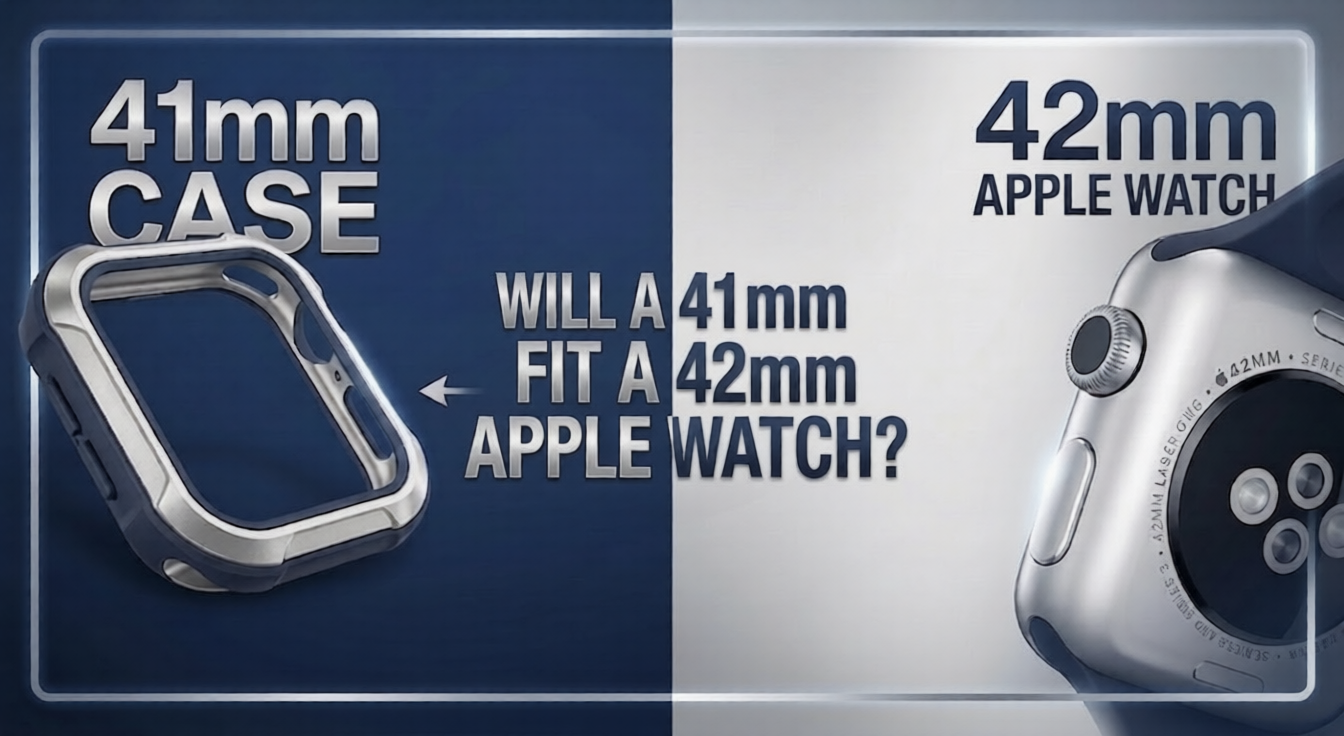
Will a 41mm Case Fit a 42mm Apple Watch?
QUICK ANSWER: Apple Watch bands are fully backward compatible, a 41mm band fits the 42mm Series 10/11. Protective cases are NOT compatible. The Series 10/11 (42mm) is 1mm narrower in chassis width and 1mm thinner (9.7mm vs. 10.7mm) than the Series 9 (41mm), making older cases either too loose or too tight to fit correctly.
If you just upgraded from a Series 7 or Series 9 to a Series 10 or 11, here is the one thing to know before you buy anything: your old bands will still work perfectly, but your old protective cases will not. This single distinction saves a lot of unnecessary returns.
Apple Watch bands use a sliding lug system that has remained physically unchanged across small-size models for years. A 41mm Hermes leather band, a Nike Sport Band, or an Apple Solo Loop slides directly onto the 42mm Series 10 and 11 with no adapter needed. You do not need to throw away a single band from your previous watch.
The ‘Two 42mms’ Confusion: Why Your Search Results Are Lying to You

Here is the problem nobody on Amazon or Reddit is explaining clearly enough: there are two completely different watches called ’42mm,’ and they share almost nothing in common physically. If you search ’42mm Apple Watch case’ today, you will see listings targeting both, and the wrong one will arrive at your door.
From 2015 to 2017, Apple used 42mm to describe the large size of the original Series 0, 1, 2, and 3. Those were thick, heavy watches with older sensor layouts. A case made for a 2017 Series 3 is physically enormous compared to the slim 2024/2025 Series 10 and 11. The dimensions are so different that the Series 3 case looks like a bumper car frame around a modern watch.
In 2024, Apple reused ’42mm’ as the small size label for the Series 10, making the naming overlap complete. Now the 42mm Series 10 and 11 are the slim, modern watches, while old ’42mm’ listings on Amazon are often legacy stock designed for hardware from 2015,2017. Buying based on the millimeter number alone without checking the model year is the fastest way to waste $15 to $40 on a case that will never fit.
BUYER WARNING: Always filter by Series 10 or Series 11 specifically, not just ’42mm.’ A case listed as ’42mm compatible’ could be designed for hardware that is nearly a decade old.
Why a 41mm Case Fails on a 42mm Series 10/11

Chassis Thickness: 9.7mm vs. 10.7mm
The Series 9 (41mm) measures 10.7mm thick. The Series 10 and 11 (42mm) measure just 9.7mm, a full millimeter thinner. In a phone case, 1mm is barely noticeable. In a watch bumper or hard-shell case with precision-molded cutouts, 1mm is the difference between a case that grips securely and one that wiggles, rattles, and falls off during a workout. A 41mm bumper on a 42mm Series 10 will never sit flush against the case back.
Sensor and Speaker Realignment
Apple redesigned the speaker system on the Series 10 and 11, moving to a finned acoustic array that spans a wider opening on the bottom edge of the watch. Cases designed for the 41mm Series 9 have a single, smaller speaker slot that blocks roughly half of the new speaker and microphone openings. Real-world result: your call volume drops noticeably and Siri has trouble picking up your voice in noisy environments.
The wide-angle OLED display on the 42mm Series 10 and 11 also extends closer to the physical edges of the case than on the 41mm Series 9. A 41mm hard case will clip the outer millimeter of the display, physically blocking the edge swipe gestures used for Control Center and Notification Center. This is not a minor annoyance, it breaks daily navigation.
The Apple Watch Band Compatibility Matrix
The band system is where Apple actually got compatibility right. Every band is designed to fit a specific lug width group, and those groups have stayed consistent across generations. The table below shows exactly which sizes share bands, use it to decide whether your existing bands survive your upgrade.
| Size Group | Fits These Watch Sizes | Bands Are Interchangeable? |
| Group 1, Small | 38mm, 40mm, 41mm, 42mm (Series 10/11) | ✅ Yes, fully compatible |
| Group 2, Large | 42mm (Series 0,3), 44mm, 45mm, 46mm, 49mm (Ultra/Ultra 2) | ✅ Yes, fully compatible |
| Cross-Group | Group 1 band on Group 2 watch (or vice versa) | ❌ No, lugs do not align |
If you are upgrading from a Series 7, 8, or 9 (all 41mm) to a Series 10 or 11 (42mm), every single band you own transfers directly. The $89 Hermes leather band, the $49 Sport Loop, the braided Solo Loop, all of them work. You are only replacing your case, not your band collection.
Why Your 41mm Case Will Fail
Even though 1mm sounds negligible, it breaks the precision molded fit required for a watch.
1. The Thinner Chassis
The Series 9 (41mm) was 10.7mm thick. The modern 42mm (Series 10/11) is a much slimmer 9.7mm.
- The Result: A 41mm case will rattle, wiggle, and likely fall off during a workout because it can’t grip the thinner body.
2. Acoustic Muffling
Apple redesigned the speaker into a finned acoustic array.
- Old 41mm cases have a single, small oval slot.
- When forced onto a Series 10/11, this slot blocks half the speaker and microphone.
- Real world impact: Siri won’t hear you, and your workout announcements will sound hollow or muffled.
3. Edge Clipping & Ghost Touches
The modern 42mm OLED display extends closer to the edges. A 41mm hard case will physically block your ability to swipe for the Control Center or Notifications. Furthermore, the poor fit creates “flex points” that cause Ghost Touches, where the watch opens apps on its own.
Community Pain Points: What Reddit Users Are Reporting
The r/AppleWatch community has been surfacing the same complaints since the Series 10 launched, and they map directly to the compatibility issues above. Reading through these threads reveals what the spec sheets miss, and what most buying guides skip entirely.
The most common complaint is Ghost Touches caused by hard cases that do not fit the thinner chassis. A case that does not sit flush against the Series 10 body creates microscopic flex points where the case presses unevenly against the screen glass. This pressure triggers phantom touch inputs, Redditors describe their watch opening apps, changing watch faces, and dismissing notifications without being touched. The fix every thread recommends is the same: remove the misfit case.
The second consistent complaint is Acoustic Muffling on calls and workouts. Users upgrading from a 41mm case to the 42mm Series 10 report that Siri responses sound hollow, speakerphone callers are noticeably quieter, and the workout announcement voice is muffled mid-run. This is the direct result of the speaker hole misalignment described above, the single-slot cutout on old 41mm cases blocks the new finned speaker array. Once users remove the old case, audio quality immediately returns to normal.
Pro Tips for Buying the Right 42mm Case

Whether you’re shopping on Amazon, Best Buy, or Apple’s own accessories page, use these filters to avoid wasting money on an incompatible case. The market is still flooded with old stock mislabeled for the new 42mm body, and the product titles are intentionally broad.
- Look for ‘Series 10’ or ‘Series 11’ in the product title, not just ’42mm.’ Any listing that says ‘Universal 40/41/42mm’ is almost certainly old inventory designed before the Series 10 redesign. These cases were manufactured to a 10.7mm thickness profile and will not grip a 9.7mm watch.
- Check the listed thickness spec, any case rated for 10.7mm or thicker is built for the Series 9 (41mm) or earlier. The correct spec for a Series 10/11 (42mm) case is 9.7mm chassis depth. If the listing does not mention thickness, ask the seller or skip it.
- Avoid multi-model bundles like ’38/40/41/42mm compatible’, these bundles use one-size-fits-most molding that fits none of the sizes precisely. They are especially problematic on the thinner Series 10 and 11 where precision fit matters most for speaker and sensor alignment.
- For speaker hole alignment, look for the word ‘finned’ or ‘dual-port’, legitimate Series 10/11 cases mention the new speaker design in their description. If the listing shows a single oval cutout in the product photo, that case was designed for a pre-Series 10 speaker layout.
- Buy from brands that list a return window, even well-reviewed cases occasionally ship with production tolerances that cause rattle on thinner watches. A 30-day return policy protects you if the fit is off on your specific unit.
Bottom line: Keep your bands, replace your case. Search ‘Series 10/11 specific’ and verify the 9.7mm thickness spec before you buy. Your wallet, and your speaker, will thank you.
Author’s Note:
As a power user, I’ve felt the frustration of hardware glitches like “Ghost Touches” firsthand.
I spend hours cross referencing sensor layouts and chassis depths to decode subtle tech shifts.
My goal is to save you a trip to the returns counter with field tested troubleshooting.
Spend less time fighting with your gear and more time actually using it.